
Need help now? Call or text 988. SAMHSA Helpline 1-800-662-4357. Overdose or emergency: 911.
ODOPOne Day, One Page
What you can writeWrite my bookMy road to recoveryTell one storyJust talkWrite a letterSit down with someoneAnswer five questionsWrite a songJokes and sayingsPitch a filmWrite my movieMy 12 StepsKeepsake boxMy peopleChips and tokensSee an example About us
Who we areWhat we doMission, vision and purposeOur cultureDogStar Recovery ResidencesFor family and friendsSupport our work
More
The LibraryHow it worksDashboardFor familiesPrivacyAboutHelpContact

Start writing freeLog in

How it works

From the first question to a book on the shelf.

You never face a blank page. Sam asks one question at a time. You answer by talking or typing. Your answers become your recovery story, word for word.

FreeFor people in recovery
Talk or typeA few words is enough
Skip anythingCome back any time
Locked to youLocked before it is saved
The route at a glance

Ten stops. No experience needed.

Here is the whole trip, from making an account to handing your family a book. Tap any stop to jump straight to it.

The journey

Every step, in order.

Scroll down. The gold line follows you.

Step one

Make your account. Save your code.

Sign up with an email and a password. Then the app shows you a recovery code, one time only.

If you ever forget your password, that code gets you back to your writing. Lose both? We can still help you back in, after checking it is really you.

  • Write it on paper and keep it with your other important papers
  • Or save it in a password manager
  • Do not email it to yourself
Recovery codeStep 1 of 2
Important. Do this now.

Save your recovery code

●●●●●●●●●●●●●●●●

Yours will be shown here once. This picture hides it on purpose.
Step two

Four quick questions. All optional.

Your name, your path, your recovery date if you want to share it, the places in your story, and why you want to write it down. Your answers fill in your book's title page and timeline, so you do not have to later. If you add a recovery date, every year of it is celebrated with an anniversary chip.

They are locked like your writing. Tap "Skip the rest" any time.

Tap the numbers to see each one.

WelcomeQuestion 1 of 4

A few quick questions

Which of these fits you?

Your recovery date

Path. Pick any that apply.

Places in your story

Towns, homes, programs and places that mattered
A short list is fine. Only general places, no addresses.

Why write it down?

Pick any that are true
Step three

Pick what to write today.

Your whole recovery story is the big one: 31 chapters, in any order. Or start smaller. One memory. A letter to someone you hurt, or to you on day one. A song. The sayings that got you through.

Or go big. Write my movie turns one true story into a real script for a movie, a TV show or a documentary.

Every project uses the same calm guide. You can do them all.

Step four

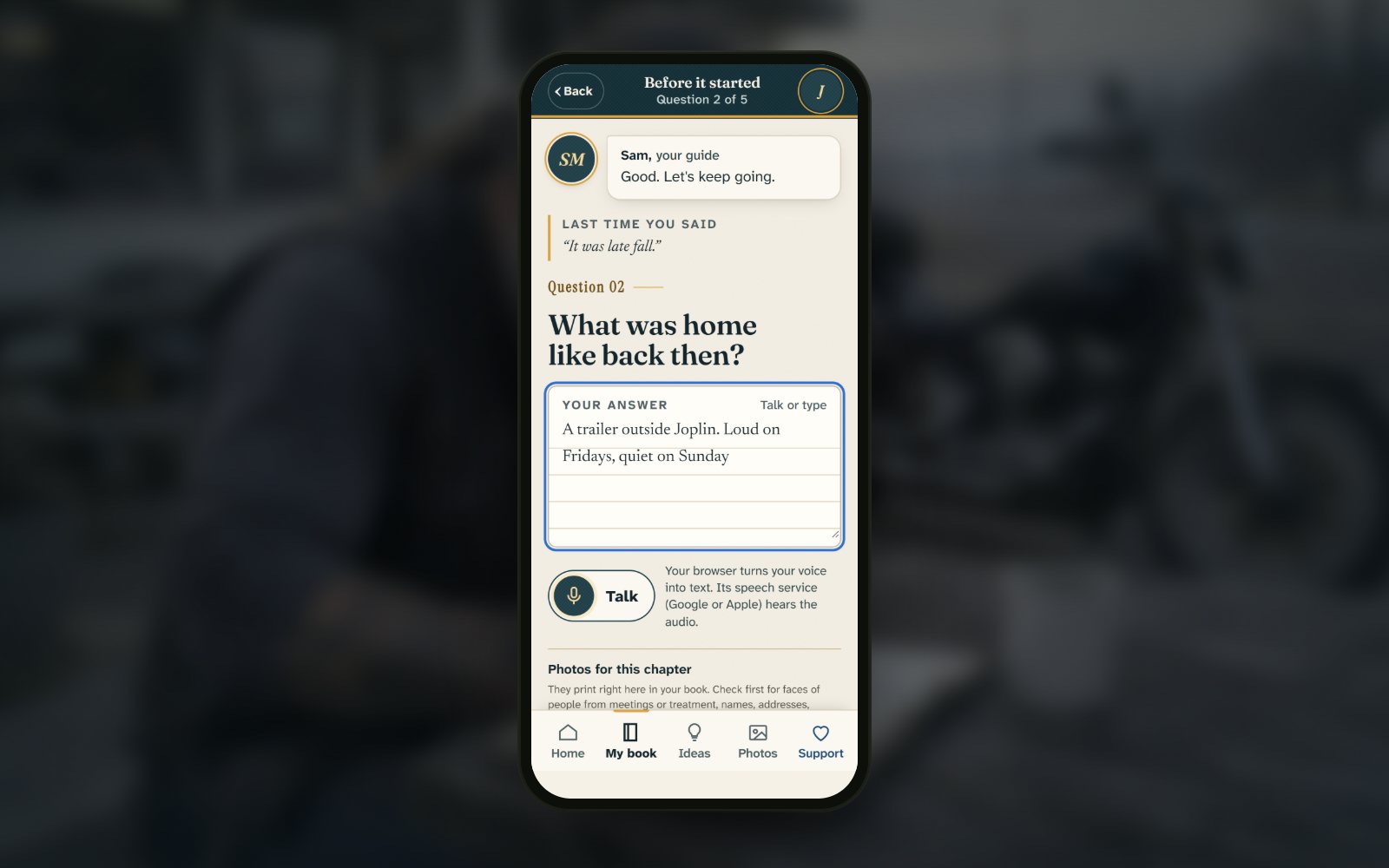
One question per screen.

Sam, your guide, asks one plain question in large type. Sam is a made-up character, not a counselor or a sponsor. Sam asks, and never writes a word for you.

Tap Talk and say your answer, then tap it again to stop. Your words appear in the box. Or type. A few words is enough.

  • An example answer sits under every question
  • Some questions offer quick picks, like Winter, Spring, Summer, Fall
  • It saves every time you tap "Save and next"
The app asking: What time of year was it? With a Talk button and quick picks for Winter, Spring, Summer and Fall
Step five

Not this one? Three ways out.

Memory has gaps. Some days are hard. So every question comes with a way around it.

  • I do not remember. That is a real answer. The question is noted so you can come back.
  • Ask it another way. A different door into the same memory.
  • Skip. On to the next one. No questions asked.

Try all three on the card.

Before it startedQuestion 1 of 3
Question 01
For example
Not this one? Three ways out
Step six

Your answers, in order.

When you finish a chapter, you see everything you said, in order. At the top is a promise:

"Every sentence here is one you said. Nothing added."

Tap "Make this my draft" and your answers become the chapter, word for word. Then change any word you like. It saves as you type.

Want it tidied up? Tap Clean it up or Editor's pass. You keep or skip every change. See the editor

The first timeYour answers
Every sentence here is one you said. Nothing added.
How old were you?
Fifteen. A summer job at the lake, the year my parents split up.
What was going on in your life back then?
Nobody was home much. I felt like I was in the way everywhere I went.
What did it feel like?
Like somebody finally turned the noise down. I remember thinking, so this is how other people feel.
Who was with you?
A boy named Eddie from the boat dock. He was the first person who ever saved me a seat.
Left out for now: Time of year. You said you did not remember. Add it later if it comes back.
Fifteen. A summer job at the lake, the year my parents split up. Nobody was home much. I felt like I was in the way everywhere I went.

Like somebody finally turned the noise down. I remember thinking, so this is how other people feel.

A boy named Eddie from the boat dock. He was the first person who ever saved me a seat.

These are example answers, made up to show how it works.

Step seven

Chapter by chapter, a book.

Your book has 31 chapters, from before it started to what you want people to know. Go in any order. A few answers is a good day.

Add a recovery date and get a second book. My years in recovery gives every year its own chapter: what you were doing, where you lived, who walked with you, the close calls, the relapses and how you came back, and the wins.

Add a title, a subtitle, your name as you want it on the cover, and a dedication. Pick one of your photos for the cover. Then tap "Read my book."

Photos go right in the chapter. Tap "Add a photo here" on any chapter and take a picture or pick one. It prints next to your words. The hidden location your phone stores in pictures is removed.

Have an old notebook or letters? Tap "Scan a page." Take a picture of each page, and the words are read in for you to check. The picture of the page is kept with them.

Write my bookGo in any order
Not startedHas answersDraft written

An example of a book in progress. Yours fills in as you go.

Step eight

Hold it in your hands.

Open any project and tap "Download PDF." For the whole book, open My book, tap "Read my book," then "Download PDF."

Email it to family. Take it to any print shop. Or use a print-on-demand service for copies with a real cover.

Getting your book printed →
A man smiles while holding his printed memoir at a library table
Your book, your name on the cover
Download PDF
Step nine

Share it, after a privacy check.

Nothing is shared unless you choose it. Before anyone else reads your story, the app asks you to check four things, so it does not hurt you or anyone in it.

Then pick a private link for family, or a public page for anyone. Private first is a good rule. You can always make it public later.

Before you share →
ShareStep 1 of 2

Privacy check

Before anyone else reads this, check each one.

Who should be able to read it?

A practice run. Nothing on this page is shared.

Step ten

Recovery is community. Write it together.

Start a Circle: a shared book, story, song or movie, and send the people who walked with you a link. They make their own free account and land right in it. Everyone writes their own chapters, and only the writer can change them.

Check in with someone. On any chapter you wrote, ask a sponsor, a friend from treatment, a family member or a mentor what they remember. Their answer comes back with their name on it, and you decide whether it goes in. The invite is discreet: it says only that you "would like your help remembering something for a story", unless you choose to say more.

It is locked so only your Circle can read it. Nobody can read it, not even us. Invites are by link only, so nobody can search for you.

The Tuesday Night CircleShared book, 3 writers
01The first Tuesdayby Dee
02The night the power went outby LuisYours
K. answered"I was by the window. You could hear Marcy laughing in the dark, and then all of us were."

Names and chapters here are a made-up example.

Whole restoration

Recovery is more than not using. It is a whole life coming back.

Writing your story shows you what has been restored, and what you still want back. Sam asks about all of it, at your pace, in your own words.

  • Body. Your health, your strength, the first morning you felt good.
  • Mind. Clear thinking, memory coming back, learning something new.
  • Spirit. Faith, meaning, quiet, whatever that means to you.
  • Food and sleep. Real meals at a table, a full night of rest.
  • Movement. A walk, a gym, a trail, a dance floor.
  • Purpose and community. Work, service to others, the people you belong to.
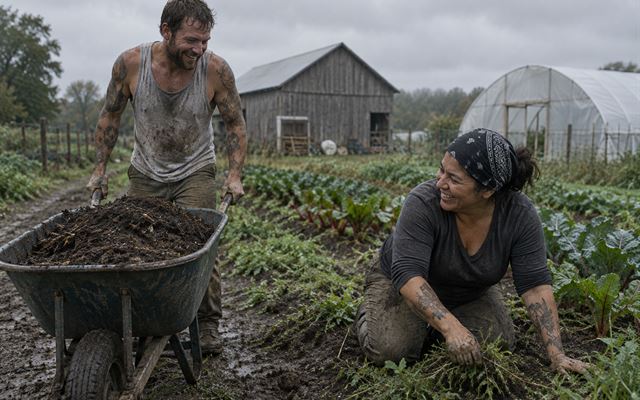
  • The land. A garden, a farm, hands in the dirt, something you grew.

A writing tool, not treatment or medical advice. Every path is welcome.

Two friends working in a vegetable garden on a small farm in the morning light
New: the editor

An editor for every kind of writing.

Every writing screen has two buttons. Use one, both or neither. Nothing changes until you say so.

Clean it up
Instant, on your phone. No AI.

It fixes spacing, filler words like "um" and "uh", doubled words like "the the", capital letters and a missing period at the end.

Editor's pass
A professional-style edit and layout.

An AI editor works to professional rules for that kind of writing. It never adds facts. It may leave a few notes on things only you can decide, like a name spelled two ways.

  • You see every change, labelled: spelling, punctuation, wording or layout.
  • Keep or skip each one.
  • Changed your mind? Put back my version brings back your own words.

Editor's pass is part of Help me write. It is off until you turn it on. Then only the text you are editing is sent, to Claude, the AI made by Anthropic. Clean it up uses no AI at all.

Tell one storyExample. Made up.
Your words
We got to the farm before sunup and um Mr Reyes handed me the the shovel. he said dont drop it. I held on to it with both hands. Reyez told that story at every dinner untill we all knew it by heart

Said out loud and typed by the Talk button. Try the two buttons. Nothing on this page is saved or sent.

Tuned to the kind of writing

What Editor's pass does for each one.

Book chapters and stories
A line edit and paragraphs. Words someone said out loud go in quotation marks.
Just talk
Turns what you said out loud into sentences and paragraphs.
Letters
Letter layout. It never adds a greeting or a closing you did not write. It tells you in a note instead.
Songs
Spelling only. It keeps your lyric sheet, your verse and chorus labels and every line. It never changes a word for rhyme.
Film pitch
Present tense, with the strongest detail first.
Sit down with someone
Interview layout: each question, then the answer.
Five questions
A very light touch. Every phrase stays.
Family and friends
Short paragraphs. It never adds names, places or dates you did not write.
Jokes and sayings
One at a time. Your own words and slang stay.
Movie and TV scripts
Screenplay style, line by line. It never changes the words a character says.
Try it right here

Meet Sam. Sam asks. You answer.

This is a practice run of step four. Type a few words, or tap "Use the example." Watch how Sam follows up with the next question.

  • Questions built for foggy memories, early days and hard days
  • Example answers to help you get started
  • Nothing you type on this page is saved or sent
SamYour guide. A practice run.
Sam
We start at the beginning. Take your time. A few words is plenty.

For example

A leather journal with a small brass lock resting on a folded sweater beside a cup of coffee
At every step

Locked on your device, before it is saved.

Your writing is locked on your own device before it ever leaves it. Nobody can read it, not even us, and anyone who breaks into a server finds only locked data.

Your writingAnswers, drafts, stories, letters, songs and titles
Your ideasEvery note in your ideas notebook
Your photosAnd their captions
Your welcome answersYour name, path, recovery date and the rest
How your privacy works →
If it gets heavy

You do not have to carry it alone.

Writing about the hard years can bring things up, including cravings. That is normal. Stop any time. Skip anything. The Support button is on every screen, and if something you type sounds heavy, the app shows these numbers. Your words are always saved first.

Overdose or emergency, call 911. One Day, One Page is a writing tool, not treatment or a crisis service, and nobody is reading in real time. Support and safety

Questions

Good to know before you start.

What do I need to sign up?
An email address and a password. Right after, the app shows your recovery code once. Save it somewhere safe before you go on.
What if I lose my recovery code?
If you can still log in, go to Account, then "Make a new recovery code." If you lose both your password and your code, tap Forgot password, then "I lost my code too." A person from our team will check that it is really you and help you back in.
Do I have to answer the welcome questions?
No. Every one is optional. Tap "Skip the rest" and go straight to your dashboard. You can fill them in later.
Do I have to go in order?
No. Start with any chapter or any project. Stop in the middle. It saves every time you tap "Save and next."
Does anyone write for me?
No. Sam asks questions and offers other ways in. Your draft is made from your answers, word for word. Every sentence is yours.
Will the editor change my words?
Only the changes you keep. Clean it up fixes spacing, filler words and capital letters on your phone, with no AI. Editor's pass is an AI editor that works to professional rules. It is part of Help me write, so it is off until you turn it on, and then only the text you are editing is sent. You keep or skip every change, and Put back my version brings back your own words. See the editor.
How does the Talk button work?
Tap Talk, say your answer, and tap it again to stop. Your browser turns your voice into text, using its own speech service from Google or Apple. If you do not see a Talk button, use the microphone on your phone's keyboard. More help.
What does the privacy check do?
Before you share, it asks you to confirm four things: first names or initials for people from meetings, treatment or groups; a moment to think about court, work, custody and family; no full names of people who were hurt without a yes; and photos checked. If you have a court case or a custody matter, think twice before making a public page. Before you share.
Can I write with other people?
Yes. Start a Circle: a shared book, story, song or movie. Tap Invite and send the link. Each person writes their own chapters. You can also check in with someone about one of yours, like a sponsor, a friend from treatment or a family member, and their answer comes back with their name on it.
Can someone in my Circle change what I wrote?
No. Only the writer can change a chapter. If you leave a Circle, you choose whether your chapters stay with your name on them, or go with you.
Can I write about a relapse?
Yes, and with respect. Most people in recovery have relapsed, many more than once, and for some a relapse is where real change began. A new recovery date never erases your earlier years or anything you wrote. The whole story stays.
Is this treatment?
No. It is a writing tool, not treatment, therapy or a program, and it works with any path: 12-step, SMART Recovery, faith-based, medication (MAT), harm reduction, a treatment program or your own way. For help with substance use, call the SAMHSA National Helpline at 1-800-662-4357.
Can I add an old notebook, letter or song?
Yes. Tap "Scan a page" and take a picture of each page. The words are read in for you to check and fix before they go anywhere. To read handwriting, the pictures are sent to Claude, the AI made by Anthropic, and are not kept there.
Is there something for family and friends?
Yes. Family and friends can sit down with someone they love, ask the family questions, and add their own side when they are asked. For family and friends.
Can I use my phone and my computer?
Yes. Log in on any device with your email and password. On a new device, you unlock your writing with your password.
Free for people in recovery

Your first question is waiting.

Make your account, save your code, and Sam takes it from there. Free, and locked so only you can read it.